Carrito de compra
Su pedido cuenta con 0 productos
Envío gratis a partir de $389.00 (Consulta T&C)
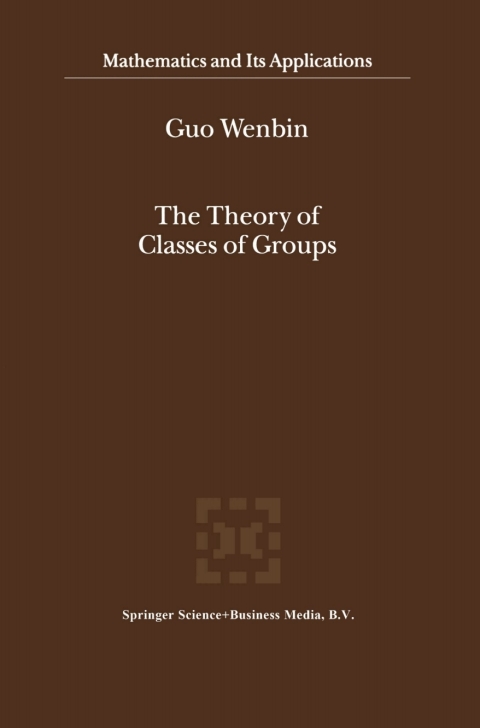
| ISBN: | 9789401140546 |
|---|---|
| Formato: | Page Fidelity |
| Idioma: | Inglés |
| Editorial: | Springer Nature |
| Tema: | Matemáticas |
| Subtema: | Álgebra abstracta |
| Año de publicación: | 2012-12-06 |
One of the characteristics of modern algebra is the development of new tools and concepts for exploring classes of algebraic systems, whereas the research on individual algebraic systems (e. g. , groups, rings, Lie algebras, etc. ) continues along traditional lines. The early work on classes of alge bras was concerned with showing that one class X of algebraic systems is actually contained in another class F. Modern research into the theory of classes was initiated in the 1930s by Birkhoffs work [1] on general varieties of algebras, and Neumanns work [1] on varieties of groups. A. I. Malcev made fundamental contributions to this modern development. ln his re ports [1, 3] of 1963 and 1966 to The Fourth All-Union Mathematics Con ference and to another international mathematics congress, striking the ories of classes of algebraic systems were presented. These were later included in his book [5]. International interest in the theory of formations of finite groups was aroused, and rapidly heated up, during this time, thanks to the work of Gaschiitz [8] in 1963, and the work of Carter and Hawkes [1] in 1967. The major topics considered were saturated formations, Fitting classes, and Schunck classes. A class of groups is called a formation if it is closed with respect to homomorphic images and subdirect products. A formation is called saturated provided that G E F whenever Gjip(G) E F.









 Este sitio web utiliza cookies para mejorar la experiencia del usuario y asegurar su funcionamiento con eficacia.
Al utilizarlo usted acepta el uso de cookies.
Este sitio web utiliza cookies para mejorar la experiencia del usuario y asegurar su funcionamiento con eficacia.
Al utilizarlo usted acepta el uso de cookies.