Carrito de compra
Su pedido cuenta con 0 productos
Envío gratis a partir de $389.00 (Consulta T&C)
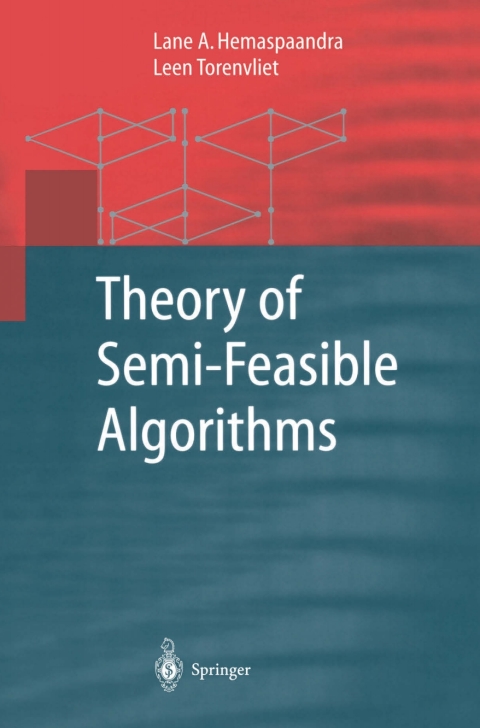
| ISBN: | 9783662050804 |
|---|---|
| Formato: | Page Fidelity |
| Idioma: | Inglés |
| Editorial: | Springer Nature |
| Tema: | Computadoras |
| Subtema: | Programación general |
| Año de publicación: | 2013-04-17 |
An Invitation to the Dance It is an underappreciated fact that sets may have various types of complex ity, and not all types are in harmony with each other. The primary goal of this book is to unify and make more widely accessible a vibrant stream of research-the theory of semi-feasible computation-that perfectly showcases the richness of, and contrasts between, the central types of complexity. The semi-feasible sets, which are most commonly referred to as the P selective sets, are those sets L for which there is a deterministic polynornial time algorithm that, when given as input any two strings of which at least one belongs to L, will output one of them that is in L. The reason we saythat the semi-feasible sets showcase the contrasts among types of complexity is that it is well-known that many semi-feasible sets have no recursive algorithms (thus their time complexitycannot be upper-bounded by standard time-complexity classes), yet all semi-feasible sets are simple in a wide range of other natural senses. In particular, the semi-feasible sets have small circuits, they are in the extended low hierarchy, and they cannot be NP-complete unless P = NP. The semi-feasible sets are fascinating for many reasons. First, as men tioned above, they showcase the fact that mere deterministic time complex ity is not the only potential type of complexity in the world of computation.









 Este sitio web utiliza cookies para mejorar la experiencia del usuario y asegurar su funcionamiento con eficacia.
Al utilizarlo usted acepta el uso de cookies.
Este sitio web utiliza cookies para mejorar la experiencia del usuario y asegurar su funcionamiento con eficacia.
Al utilizarlo usted acepta el uso de cookies.