Carrito de compra
Su pedido cuenta con 0 productos
Envío gratis a partir de $389.00 (Consulta T&C)
| ISBN: | 9783662450215 |
|---|---|
| Formato: | ePub |
| Idioma: | Inglés |
| Editorial: | Springer Nature |
| Tema: | Ciencia |
| Subtema: | Química orgánica |
| Año de publicación: | 2014-11-05 |
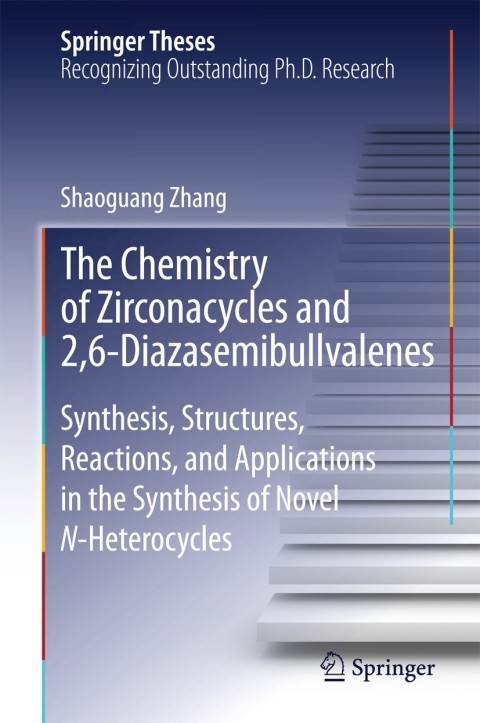
In this thesis, the author introduces two strategies used to construct various types of N-heterocycles, based on the chemistry of zirconacycles and 2,6-diazasemibullvalenes. In the first part, the author presents the development of multi-component cyclization of a zirconacyclobutene-silacyclobutene fused compound, nitriles and unsaturated compounds. These reactions provide synthetically useful methodology for various N-heterocycles such as 3-acyl pyrrole, pyrrolo[3,2-d]pyridazine and dihydropyrroloazepine, which are all difficult to synthesize by other means. The isolation and characterization of the key three-fused-ring Zr/Si-containing intermediates are also described in detail. These results show that the zirconacyclobutene-silacyclobutene fused compound behaves as a “chemical transformer� upon treatment with various substrates via the “coordination-induced skeleton rearrangement� mechanism. In the second part, the author demonstrates the synthesis and isolation of a series of 2,6-diazasemibullvalenes (NSBVs) from the reaction of 1,4-dilithio-1,3-dienes and nitriles, highlighting the significant progress made for the first time in this work: (1) determination of X-ray crystal structure of a substituted 2,6-diazasemibullvalene; (2) measurement of the activation barrier of its rapid intramolecular aza-Cope rearrangement in solution; (3) exploration of several reaction types of NSBV with diverse ring-expansion products and “bowl-shape� or “cage-shape� N-containing polycyclic skeletons; (4) demonstration of the localized structure as the predominant form and the homoaromatic delocalized structure as a minor component in the equilibrium using theoretical analysis. Based on well-founded results, this work sheds new light on this controversial topic.






 Este sitio web utiliza cookies para mejorar la experiencia del usuario y asegurar su funcionamiento con eficacia.
Al utilizarlo usted acepta el uso de cookies.
Este sitio web utiliza cookies para mejorar la experiencia del usuario y asegurar su funcionamiento con eficacia.
Al utilizarlo usted acepta el uso de cookies.