Carrito de compra
Su pedido cuenta con 0 productos
Envío gratis a partir de $389.00 (Consulta T&C)
| ISBN: | 9789819627189 |
|---|---|
| Formato: | ePub |
| Idioma: | Inglés |
| Editorial: | Springer Nature |
| Tema: | Computadoras |
| Subtema: | Ciencia de computación |
| Año de publicación: | 2025-05-31 |
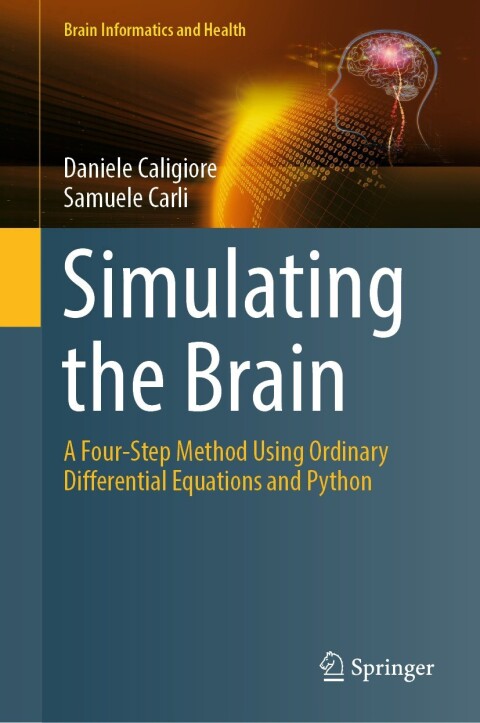
This book presents a new methodology to develop system-level brain models using ordinary differential equations (ODE), which are to be solved and analyzed through simple Python scripts. Computer simulations of this kind of models allow the study of healthy and damaged brain functions, the discovery of new neural pathways that may be crucial for the emergence of pathologies, and to simulate the effects of possible new therapies acting on brain actors which are difficult to investigate in traditional research.The methodology consists of four steps: (i) design the model architecture which represents the interactions between different brain areas; (ii) write the ODE system which are implied by the model; (iii) build a Python script that correctly solves the equations; (iv) optimize the free model parameters using genetic algorithms or other techniques to obtain one or more model instances that reproduce the target investigated behavior.This book is for all people who want to learn how to use Python and ODE to simulate brain functions regardless of their backgrounds. While rigorous mathematical proofs of many aspects of the arguments discussed are out of the scope of this work and are therefore omitted, the most important concepts necessary for the critical judgment and self-assessment of the practitioner work are exposed in a simplified, readily applicable form, with extensive references for the adventurous reader to explore. The book is a self-consistent textbook containing all pieces necessary to learn from scratch: from the essential mathematical and computing tools to the knowledge necessary to design, simulate, visualize, and interpret brain models. These skills are acquired through several hands-on examples explained step-by-step. One important and distinctive aspect of the book is that, beside the theory, it provides the necessary contexts and practical examples which are key to the correct application of the proposed methodology. Â











 Este sitio web utiliza cookies para mejorar la experiencia del usuario y asegurar su funcionamiento con eficacia.
Al utilizarlo usted acepta el uso de cookies.
Este sitio web utiliza cookies para mejorar la experiencia del usuario y asegurar su funcionamiento con eficacia.
Al utilizarlo usted acepta el uso de cookies.