Carrito de compra
Su pedido cuenta con 0 productos
Envío gratis a partir de $389.00 (Consulta T&C)
| ISBN: | 9783031848377 |
|---|---|
| Formato: | ePub |
| Idioma: | Inglés |
| Editorial: | Springer Nature |
| Tema: | Negocios y economía |
| Subtema: | Ciencia de la gestión |
| Año de publicación: | 2025-05-05 |
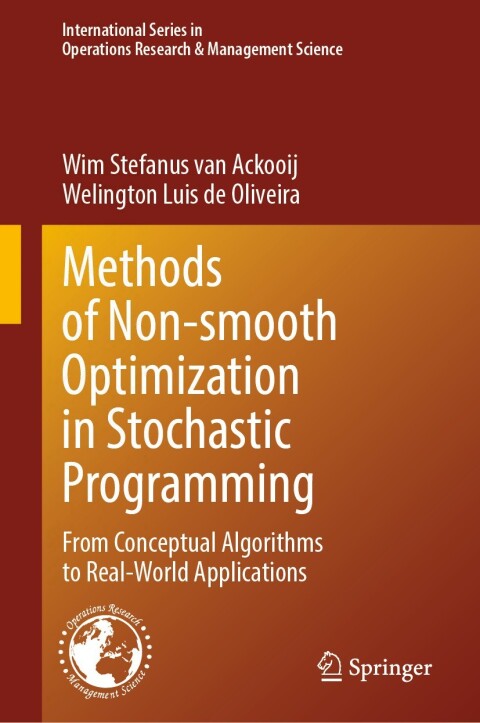
This book presents a comprehensive series of methods in nonsmooth optimization, with a particular focus on their application in stochastic programming and dedicated algorithms for decision-making under uncertainty. Each method is accompanied by rigorous mathematical analysis, ensuring a deep understanding of the underlying principles. The theoretical discussions included are essential for comprehending the mechanics of various algorithms and the nature of the solutions they provide—whether they are global, local, stationary, or critical. The book begins by introducing fundamental tools from set-valued analysis, optimization, and probability theory. It then transitions from deterministic to stochastic optimization, starting with a thorough discussion of modeling, understanding uncertainty, and incorporating it into optimization problems. Following this foundation, the book explores numerical algorithms for nonsmooth optimization, covering well-known decomposition techniques and algorithms for convex optimization, mixed-integer convex programming, and nonconvex optimization. Additionally, it introduces numerical algorithms specifically for stochastic programming, focusing on stochastic programming with recourse, chance-constrained optimization, and detailed algorithms for both risk-neutral and risk-averse multistage stochastic programs. The book guides readers through the entire process, from defining optimization models for practical problems to presenting implementable algorithms that can be applied in practice. It is intended for students, practitioners, and scholars who may be unfamiliar with stochastic programming and nonsmooth optimization. The analyses provided are also valuable for practitioners who may not be interested in convergence proofs but wish to understand the nature of the solutions obtained.











 Este sitio web utiliza cookies para mejorar la experiencia del usuario y asegurar su funcionamiento con eficacia.
Al utilizarlo usted acepta el uso de cookies.
Este sitio web utiliza cookies para mejorar la experiencia del usuario y asegurar su funcionamiento con eficacia.
Al utilizarlo usted acepta el uso de cookies.