Carrito de compra
Su pedido cuenta con 0 productos
Envío gratis a partir de $389.00 (Consulta T&C)
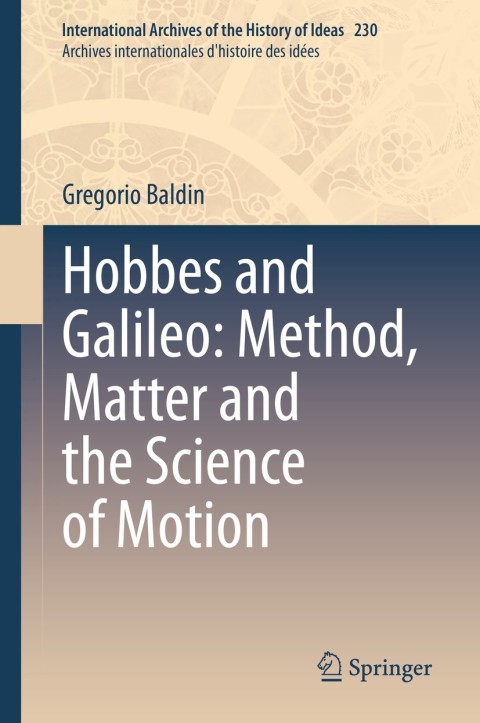
| ISBN: | 9783030414146 |
|---|---|
| Formato: | ePub |
| Idioma: | Inglés |
| Editorial: | Springer Nature |
| Tema: | Ciencia |
| Subtema: | Historia |
| Año de publicación: | 2020-04-15 |
This book, translated from Italian, discusses the influence of Galileo on Hobbes’ natural philosophy. In his De motu, loco et tempore or Anti-White (~ 1643), Thomas Hobbes describes Galileo as “the greatest philosopher of all times�, and in De Corpore (1655), the Italian scientist is presented as the one who “opened the door of all physics, that is, the nature of motion.� The book gives a detailed analysis of Galileo legacy in Hobbes philosophy, exploring four main issues: a comparison between Hobbes’ and Mersenne natural philosophies, the Galilean Principles of Hobbes’ philosophical system, a comparison between Galileo momentum and Hobbes conatus , and Hobbes’ and Galileo theories of matter. The book also analyses the role played by Marin Mersenne, in spreading Galileo ideas in France, and as a discussant of Hobbes. It highlights the many aspects of Hobbes’ relationship with Galileo: the methodological and epistemological elements, but also the conceptual and the lexical analogies in the field of physics, to arrive, finally, at a close comparison on the subject of the matter. From this analysis emerges a shared mechanical conception of the universe open and infinite, that replaces the Aristotelian cosmos, and which is populated by two elements only: matter and motion.




 Este sitio web utiliza cookies para mejorar la experiencia del usuario y asegurar su funcionamiento con eficacia.
Al utilizarlo usted acepta el uso de cookies.
Este sitio web utiliza cookies para mejorar la experiencia del usuario y asegurar su funcionamiento con eficacia.
Al utilizarlo usted acepta el uso de cookies.