Carrito de compra
Su pedido cuenta con 0 productos
Envío gratis a partir de $389.00 (Consulta T&C)
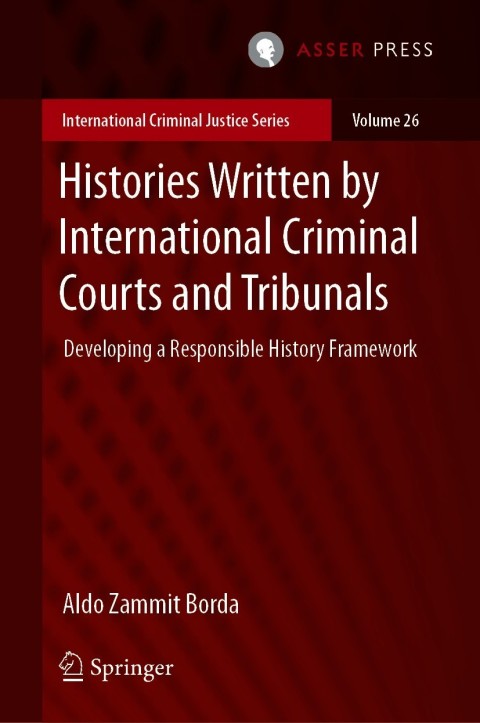
| ISBN: | 9789462654273 |
|---|---|
| Formato: | ePub |
| Idioma: | Inglés |
| Editorial: | Springer Nature |
| Tema: | Derecho |
| Subtema: | Internacional |
| Año de publicación: | 2020-12-18 |
This book argues for a more moderate approach to history-writing in international criminal adjudication by articulating the elements of a “responsible history� normative framework. The question of whether international criminal courts and tribunals (ICTs) ought to write historical narratives has gained renewed relevance in the context of the recent turn to history in international criminal law, the growing attention to the historical legacies of the ad hoc Tribunals and the minimal attention paid to historical context in the first judgment of the International Criminal Court. The starting point for this discussion is that, in cases of mass atrocities, prosecutors and judges are inevitably understood to be engaged in writing history and influencing collective memory, whether or not they so intend. Therefore, while writing history is an inescapable feature of ICTs, there is still today a significant lack of consensus over the proper place of this function. Since Hannah Arendt articulated her doctrine of strict legality, in response to the prosecutor expansive didactic approach in Eichmann, the legal debate on the subject has been largely polarised between restrictive and expansive approaches to history-writing in mass atrocity trials. What has been noticeably missing from this debate is the middle ground. The contribution this book seeks to make is precisely to articulate a framework that occupies that ground. The book asks: what are the lenses through which judges of ICTs interpret historical events, what kind of histories do ICTs write? and what kinds of histories should ICTs produce? Its arguments for a more moderate approach to history-writing are based on three distinct, but interrelated grounds: (1) Truth and Justice; (2) Right to Truth; and (3) Legal Epistemology. Different target audiences may benefit from this book. Court officials and legal practitioners may find the normative framework developed hereinuseful in addressing the tensions between the competing objectives of ICTs and, in particular, in assessing the value of the history-writing function. Lawyers, historians and other academics may also find the analysis of the strengths, constraints and blind spots of the historical narratives written by ICTs interesting. This issue is particularly timely in view of current debates on the legacies of ICTs. Aldo Zammit Borda is Director of the Centre for Access to Justice and Inclusion at Anglia Ruskin University, Cambridge, UK.






 Este sitio web utiliza cookies para mejorar la experiencia del usuario y asegurar su funcionamiento con eficacia.
Al utilizarlo usted acepta el uso de cookies.
Este sitio web utiliza cookies para mejorar la experiencia del usuario y asegurar su funcionamiento con eficacia.
Al utilizarlo usted acepta el uso de cookies.