Carrito de compra
Su pedido cuenta con 0 productos
Envío gratis a partir de $389.00 (Consulta T&C)
| ISBN: | 9788847028920 |
|---|---|
| Formato: | Page Fidelity |
| Idioma: | Inglés |
| Editorial: | Springer Nature |
| Tema: | Ciencia |
| Subtema: | Física matemática y computacional |
| Año de publicación: | 2013-03-30 |
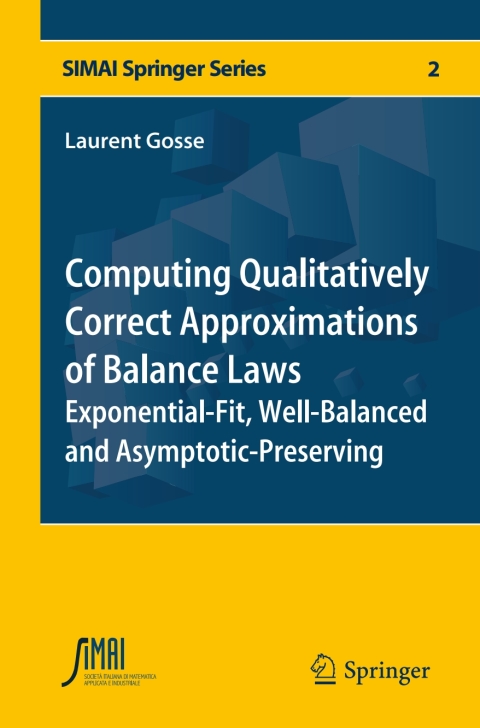
Substantial effort has been drawn for years onto the development of (possibly high-order) numerical techniques for the scalar homogeneous conservation law, an equation which is strongly dissipative in L1 thanks to shock wave formation. Such a dissipation property is generally lost when considering hyperbolic systems of conservation laws, or simply inhomogeneous scalar balance laws involving accretive or space-dependent source terms, because of complex wave interactions. An overall weaker dissipation can reveal intrinsic numerical weaknesses through specific nonlinear mechanisms: Hugoniot curves being deformed by local averaging steps in Godunov-type schemes, low-order errors propagating along expanding characteristics after having hit a discontinuity, exponential amplification of truncation errors in the presence of accretive source terms... This book aims at presenting rigorous derivations of different, sometimes called well-balanced, numerical schemes which succeed in reconciling high accuracy with a stronger robustness even in the aforementioned accretive contexts. It is divided into two parts: one dealing with hyperbolic systems of balance laws, such as arising from quasi-one dimensional nozzle flow computations, multiphase WKB approximation of linear Schrödinger equations, or gravitational Navier-Stokes systems. Stability results for viscosity solutions of onedimensional balance laws are sketched. The other being entirely devoted to the treatment of weakly nonlinear kinetic equations in the discrete ordinate approximation, such as the ones of radiative transfer, chemotaxis dynamics, semiconductor conduction, spray dynamics or linearized Boltzmann models. “Caseology� is one of the main techniques used in these derivations. Lagrangian techniques for filtration equations are evoked too. Two-dimensional methods are studied in the context of non-degenerate semiconductor models.










 Este sitio web utiliza cookies para mejorar la experiencia del usuario y asegurar su funcionamiento con eficacia.
Al utilizarlo usted acepta el uso de cookies.
Este sitio web utiliza cookies para mejorar la experiencia del usuario y asegurar su funcionamiento con eficacia.
Al utilizarlo usted acepta el uso de cookies.