Carrito de compra
Su pedido cuenta con 0 productos
Envío gratis a partir de $389.00 (Consulta T&C)
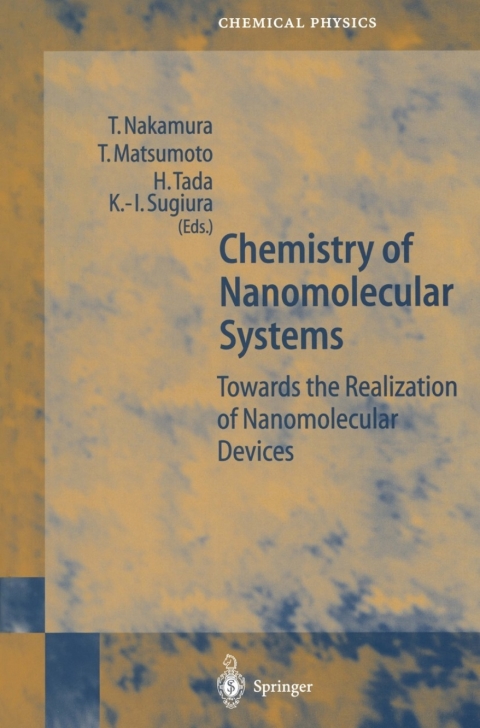
| ISBN: | 9783662052501 |
|---|---|
| Formato: | Page Fidelity |
| Idioma: | Inglés |
| Editorial: | Springer Nature |
| Tema: | Ciencia |
| Subtema: | Química general |
| Año de publicación: | 2013-03-14 |
Recently, molecular electronics, especially that utilizing single molecules, has been attracting much attention. This is mainly because the theoretical limit is approaching in the present silicon-based technology, and the development of an alternative process is strongly desired. Single-molecule electronics is aimed at a breakthrough toward the next generation of computing systems. By designing and synthesizing highly functionalized molecules of nanometer size and incorporating these molecules into electrical circuits, we shall obtain much dense and high-speed processors. The concept of single-molecule electronics was first introduced by Aviram and Ratnar in 1978. In the early 1980s, many groups all over the world had started research on molecular electronics. At that time, single-molecule manipulation techniques had not been born, and the research was mainly carried out on molecular films formed by the Langmuir~Blodgett technique, a wet process, and by molecular-beam epitaxy, a dry process. A number of prototypes of switching devices and logic gates were, however, reported in the 1980s. In the early 1990s, scanning probe microscopes became popular and researchers obtained a single-molecule manipulation and evaluation tech nique. It became possible to fabricate practical devices using single molecules or small numbers of molecules. Finally, at the end of the last century, an explosion in the research field of single-molecule electronics was witnessed. In addition, studies of "biocomputing" started in the early 1980s and significant progress was achieved in the last century.










 Este sitio web utiliza cookies para mejorar la experiencia del usuario y asegurar su funcionamiento con eficacia.
Al utilizarlo usted acepta el uso de cookies.
Este sitio web utiliza cookies para mejorar la experiencia del usuario y asegurar su funcionamiento con eficacia.
Al utilizarlo usted acepta el uso de cookies.